
INTRODUCTION
Even if my works are totally interconnected, I organize them in three sections: CORPUS, LUMEN and MACHINA. The first two name familiar territories — the body and its material works, and light as captured through the lens of a camera — with a long history in art and academia. The third is different. MACHINA names not a material nor a quality but a mechanism: the machine, the generated, the processed. Three linked concepts that define with precision a specific way of working with AI.
For me, what is generated with artificial intelligence is the equivalent of processed food: not healthy in excess — science confirms this — but not harmful in measured doses either, and when handled with judgement, capable of delivering enormous amounts of pleasure. Other concepts that suits well the topic discussed here are engineered food, fast food or convenience food. MACHINA brings together that processed work — generated by the machine, directed by the artist to avoid the ultra processed — where the tool executes and human judgement decides what, how much, and to what end.
I don’t use artificial intelligence as an automation tool but as an interpreter — one that must be addressed with precision, whose nature and language must be understood, and whose output must be directed with intention so that it executes what the artist needs, not what its so-called intelligence proposes by default.
This section brings together some of my projects where AI is the primary medium or tool for building atmospheres and other conceptual developments. In all of them, the process and the seed — which, once planted and tended, eventually germinated — are as much a part of the work as the result. That is why it is documented, explained and made visible. With as few automatisms as possible and as many premeditated decisions as can be made.
PROJECT 1: TRÁNSITO
TRÁNSITO is a sound work in twelve movements built as a continuous journey along the equatorial belt of the planet. Each movement takes its name from a real border crossing — a bridge, a passage, a link between two territories — and proposes a specific sonic landscape generated from research into the musical traditions, instruments and atmospheres of each geographic area.
The journey begins at one point along the equator and advances without stopping. When the ocean makes physical passage impossible, the work draws on historical and cultural connections — trade routes, migrations, influences — to build a temporal bridge that allows the transit to continue. The connection between Japan and Peru, for example, requires no physical bridge: it requires acknowledging centuries of Japanese presence in South America.
The result is a sonic journey in which sound, colour and texture shift progressively from one movement to the next, the way a landscape changes seen through the window of a train that never stops.
PROCESS AND METHOD
TRÁNSITO begins with a sonic and historical investigation of each geographic area represented in the work — its musical styles, instruments, rhythms and atmospheres across time. From that research I built a prompt architecture for Suno designed not only to generate each piece individually but to make the twelve movements work as a coherent journey: so that one atmosphere would lead naturally into the next, that changes would be gradual rather than abrupt, that the whole would have an internal logic.
Once the material was generated, I broke it down into layers — instruments, voices, ambient elements — incorporating also layers from discarded versions that contributed elements of interest. With that selection of layers I worked in Adobe Audition on the final assembly: gain adjustments, balance between layers, aesthetic decisions about where to take each movement and how to connect it to the next.
A THOUGHT
Working with generative AI on a project of this nature requires a clear position before anything begins: the tool does not make artistic decisions — it executes them. For that to be possible, the artist must first adopt the role of architect — defining with precision what they want to obtain — and of linguist — learning the specific language of the tool in order to request it with exactness.
In TRÁNSITO this meant designing a prompt architecture that did not merely describe sounds but anticipated relationships between pieces, transitions, coherence of the whole. AI as the interpreter of a score written in natural language.
This position has a direct consequence for the preservation of the work. If the generated material is preserved broken down into layers — and not only as a final audio file — the work can be examined, documented and potentially reconstructed. Not identically, because models change and results vary, but intelligibly: it is possible to know what was requested, why, and with what result. The archive is not only the sound — it is the decision that produced it.
The question TRÁNSITO leaves open is whether that is enough. And that question has no answer yet.
PROJECT 2: EL ARTE COMO PRUEBA (The Art as Evidence)
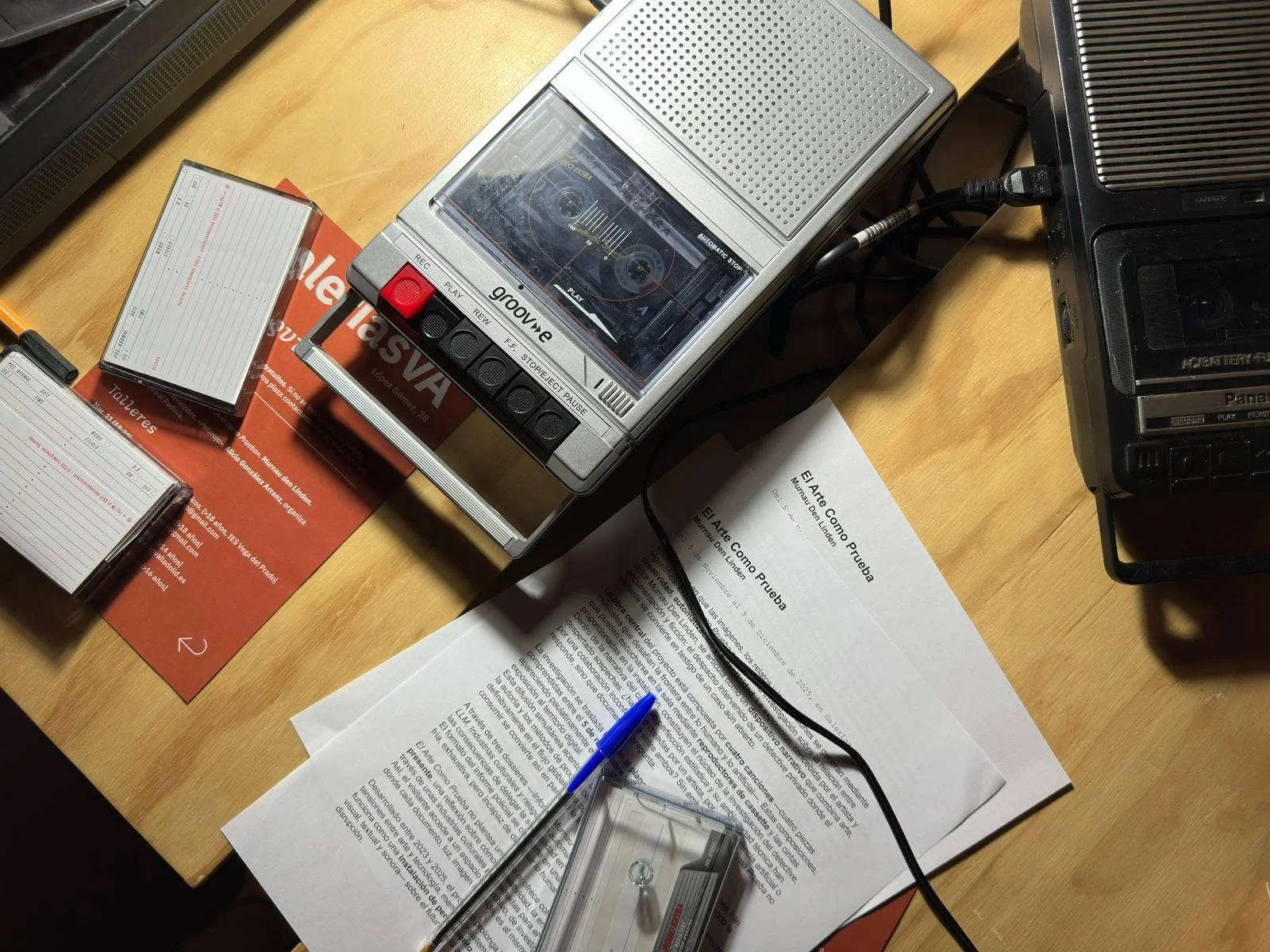
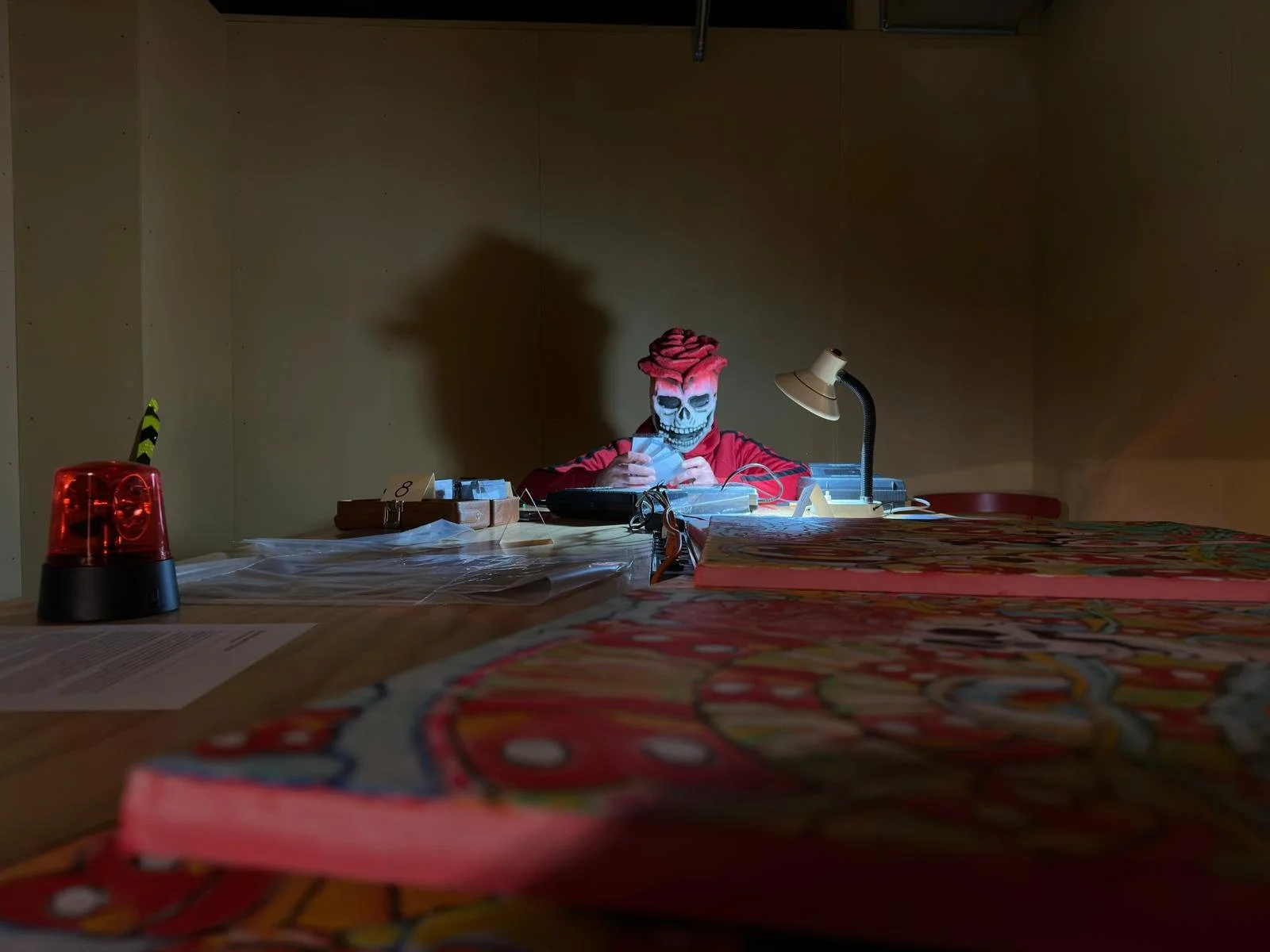
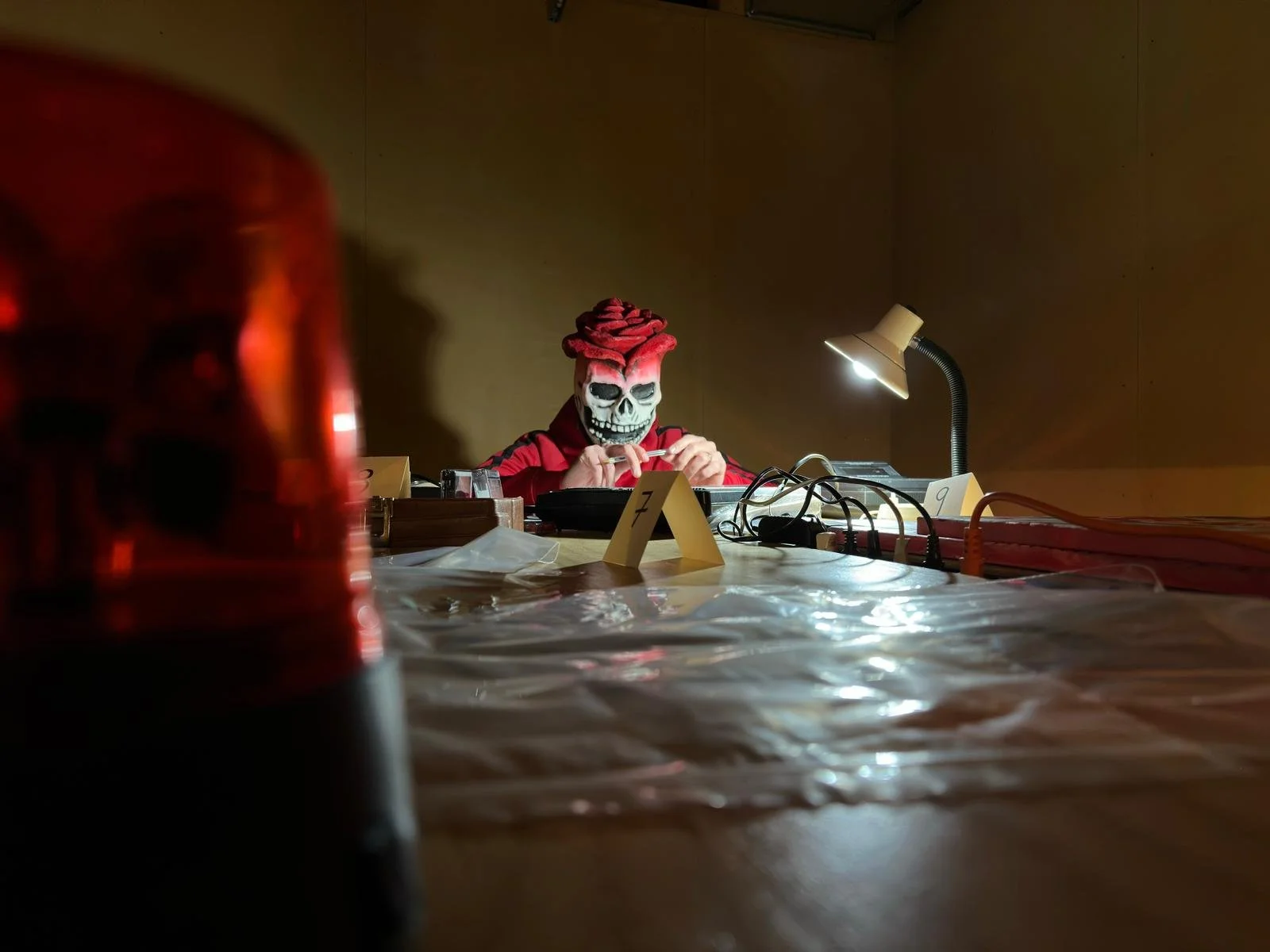
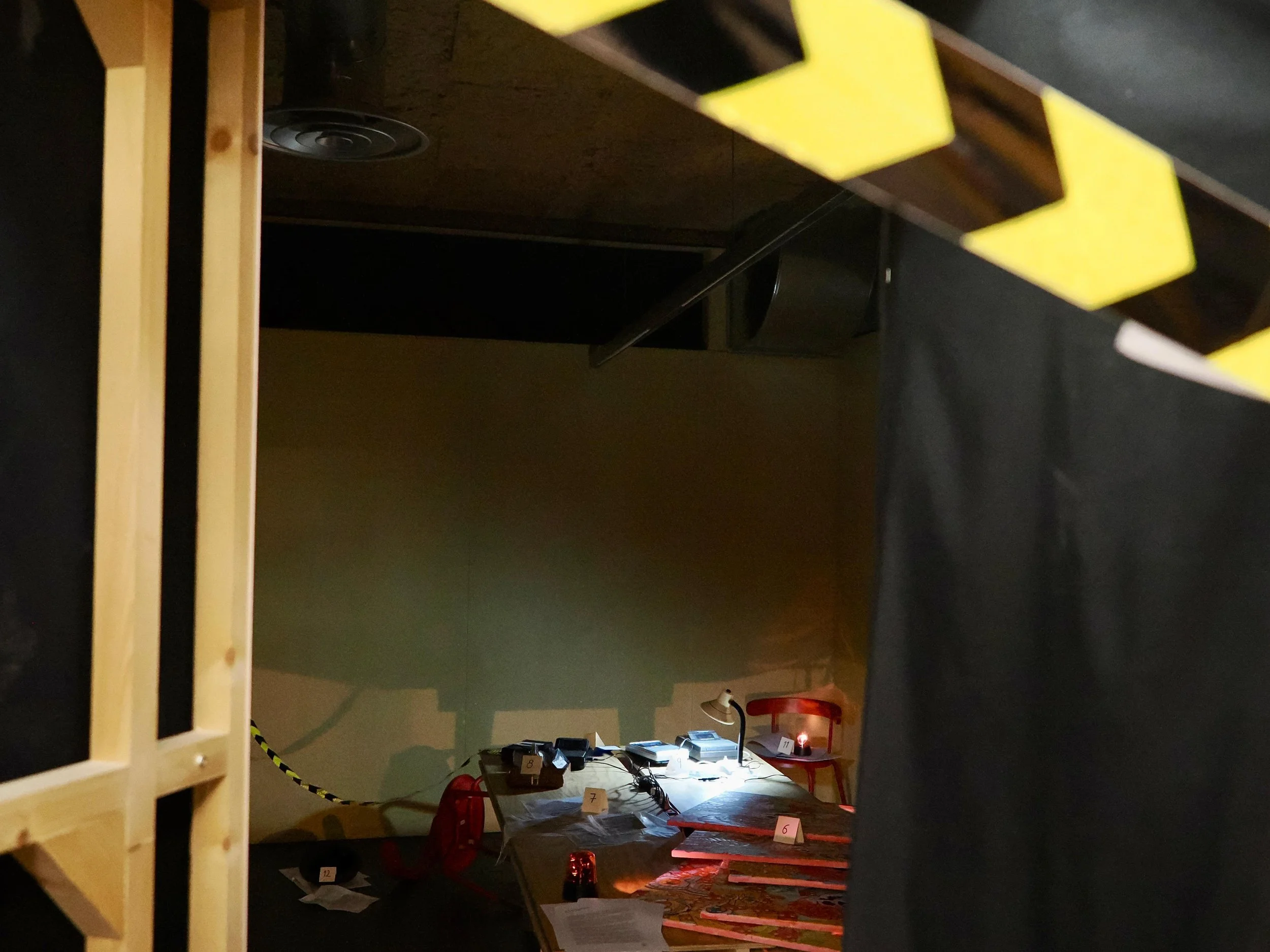
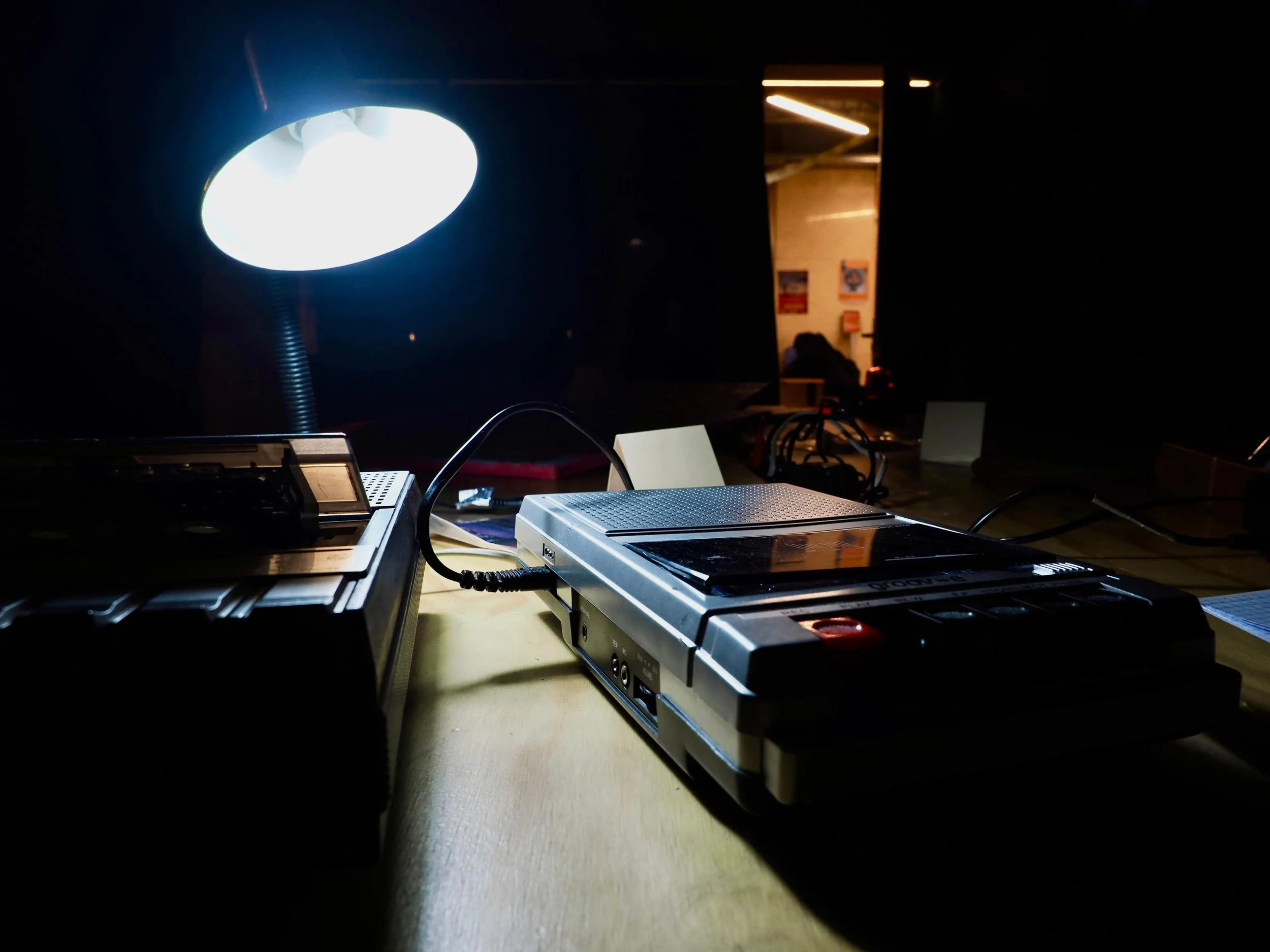
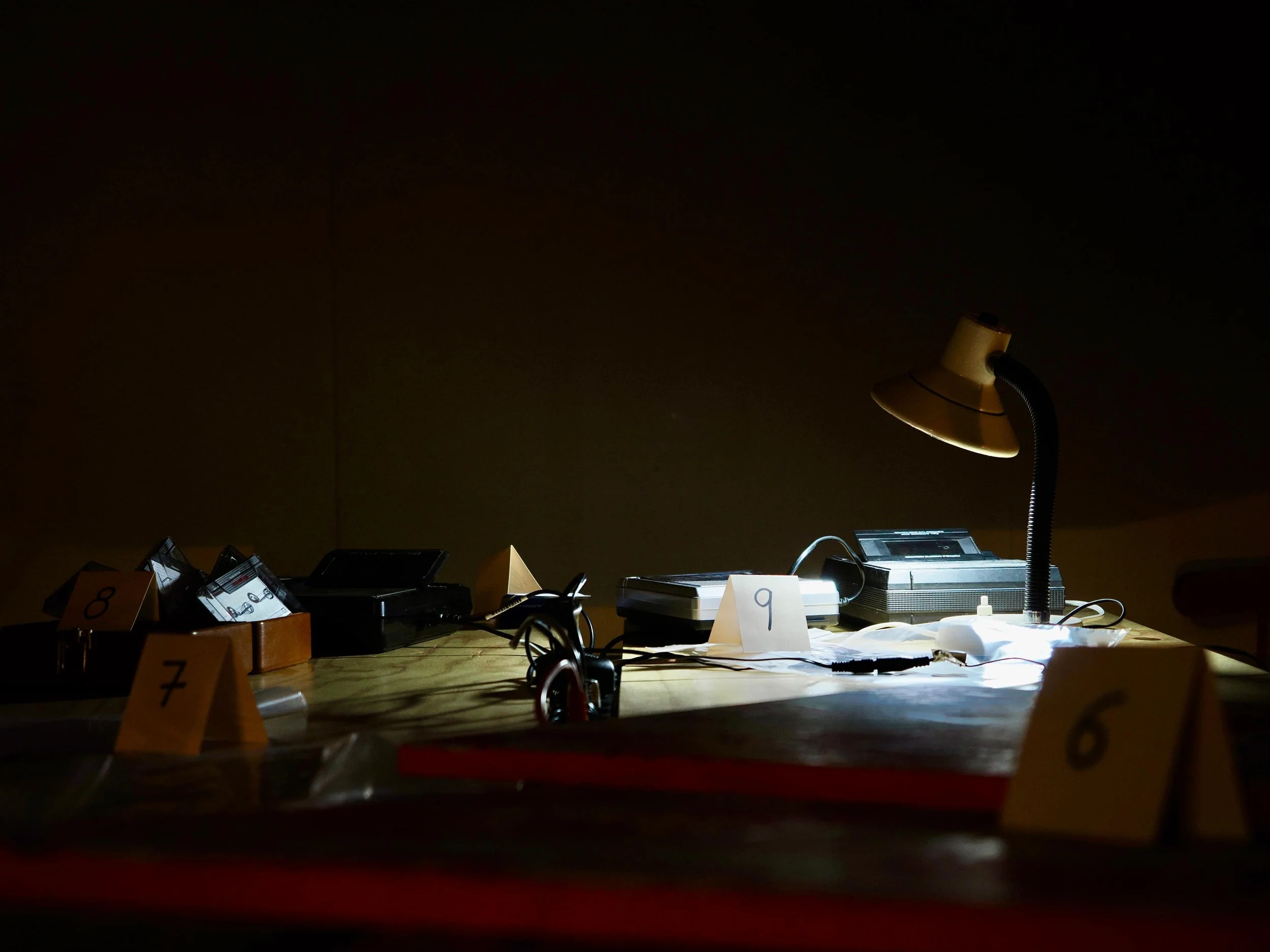
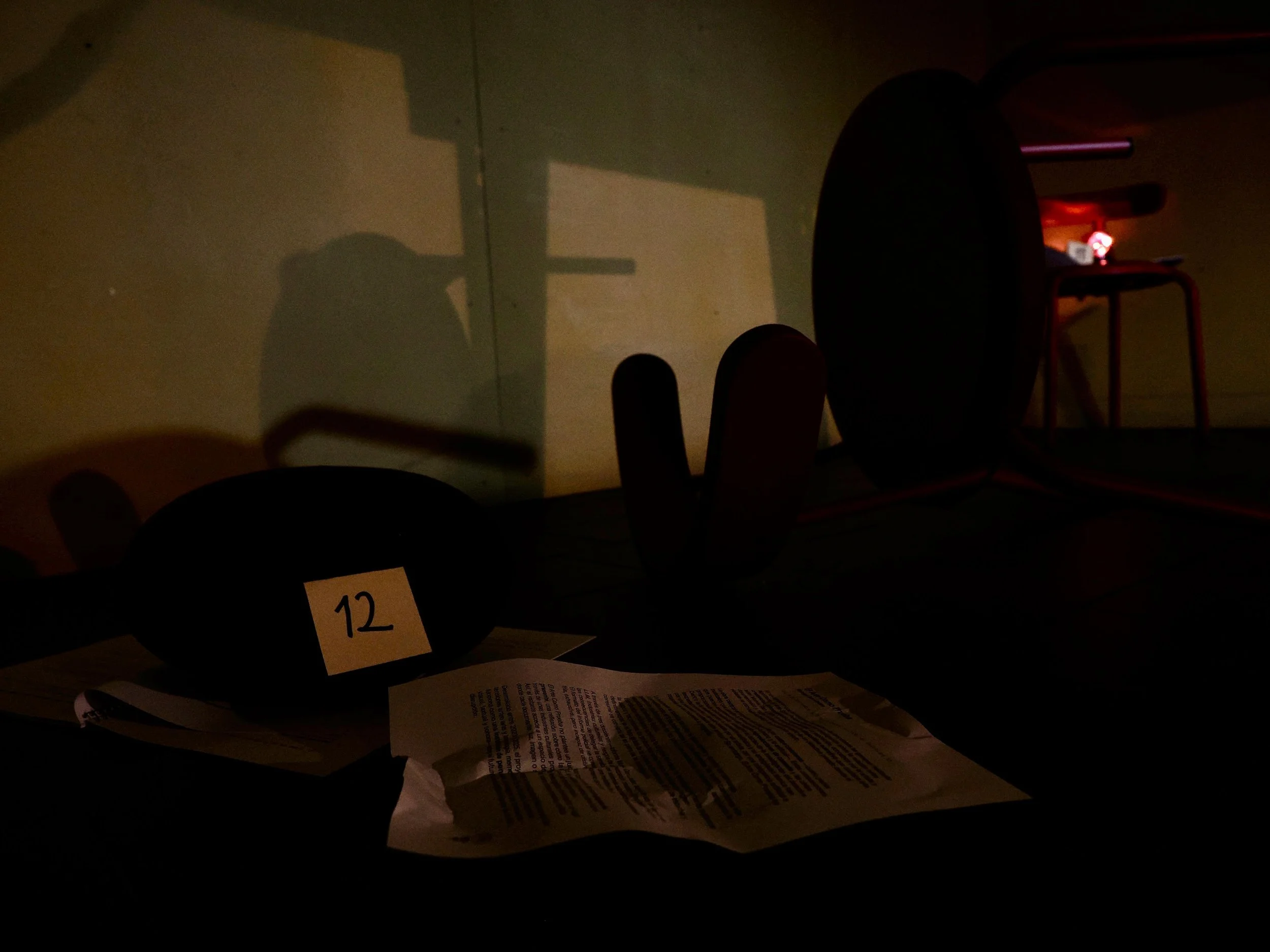
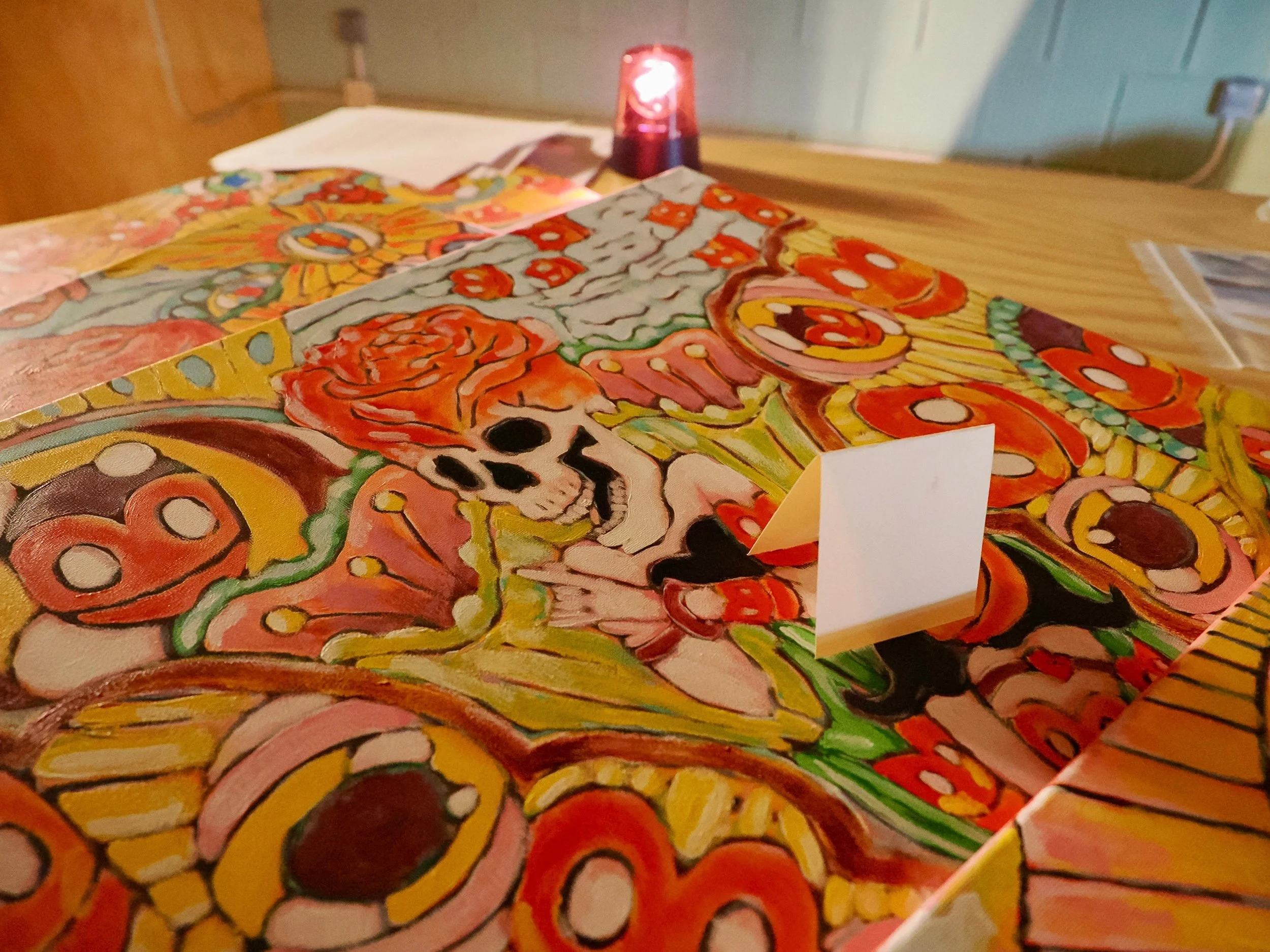
EL ARTE COMO PRUEBA is a narrative installation that investigates the relationship between creativity, automation and authenticity. It premiered at Galerías VA, Valladolid, Spain (2025). The visitor enters the staged office of a private detective — a room with no general lighting, articulated through individual points of light, each with its own narrative: rotating red police lights, a construction site work lamp, looms that partition off a restricted area, a desk lamp illuminating a workspace where someone should be working but isn't. On a long table, dozens of scattered pieces of evidence — photographs, reports, typewritten pages, three dossiers — and four cassette tapes containing the central exhibits of the case, playable on flat vintage cassette players distributed around the room.
The central work consists of four songs — a ranchera, a fado, a tango and a bulería — of such stylistic precision and technical ambiguity that it is impossible to determine their origin. Were they created by an artist, by an artificial intelligence, or by an unacknowledged collaboration between the two? EL ARTE COMO PRUEBA does not answer. It documents the question.
It is an autopsy of the present: a reflection on how creativity, emotion and truth survive within cultural industries programmed for mass consumption.
PROCESS AND METHOD
The project departs from a concrete technical premise: if generative AI can produce music in pure folk genres — ranchera, fado, tango, bulería — indistinguishable from human performance, and in certain stylistic parameters even exceeding it, then the argument for authenticity as a commercial value becomes indefensible.
To test this I built a prompt architecture designed to generate four pieces that would not merely sound authentic but would exceed the standard benchmarks of each genre. The criterion was not technical perfection but unidentifiability. Once the material was generated I worked in Adobe Audition on the assembly and adjustments needed to bring each piece to its point of maximum ambiguity.
The physical installation — the detective's office, the dossiers, the cassettes — was constructed as a narrative device to contextualise the songs within a plausible fiction. Three dossiers available to download articulate the conceptual framework of the investigation: Murnau Den Linden Report, A Guide to AI and LLMs, and Cultural Industries and the Risks of Creative Automation. The police report format as a metaphor for the contemporary gaze: cold, exhaustive, yet incapable of distinguishing the human from its simulacrum.
During the month the exhibition ran — 5 November to 5 December 2025 — the four songs were gradually released on streaming platforms, extending the investigation into digital territory. The act of listening and consuming became part of the work.
A THOUGHT
EL ARTE COMO PRUEBA does not pass judgement on AI or offer conclusions about it. What it proposes is more uncomfortable: that the cultural industry does not fear AI replacing artists — it fears losing control over what AI produces and being unable to identify its origin. The problem is not artificial creativity. It is the control over it.
This has a direct consequence for preservation. The four songs exist as audio files. They also exist as physical cassette tapes. They exist as part of an installation that can no longer be reproduced on the same terms — the space, the light, the documents, the players are as much part of the work as the sound itself. What is preserved when The Art as Evidence is preserved? The audio files? The installation? The question it raised?
The work was conceived between 2023 and 2025 as part of a broader investigation into the tensions between art and technology, memory and system. It functions as a thinking installation — an essay in three dimensions, visual, textual and sonic — on the future of authenticity in times of disruption. And that question, unlike the songs, has no file format.